5 Most Profitable Futures Trading Strategies for 2026

Introduction
Making money in futures trading is possible, but without the right strategy, it can quickly
turn into gambling. In 2026, traders in the Indian market dealing with NIFTY, BANKNIFTY,
Gold, and Crude Oil futures need proven approaches. Here are 5 strategies that work for
everyone—from beginners to experienced traders.
1. Trend-Following Strategy – Go With the Flow, Not Against It
What is This Strategy?
This is the simplest yet most powerful strategy. Identify the market trend (up or down) and trade in that direction.
When to Use:
- When the market is in a strong trend
- When index or commodity futures show high volatility
Tools You Need:
- 20 EMA and 50 EMA crossover
- ADX (Average Directional Index) above 25
- Volume and Open Interest confirmation
Real Example – NIFTY Futures:
Imagine NIFTY is trading above the 50 EMA, Open Interest is rising, and ADX is at 30—this signals a strong uptrend.
- Entry: Take a long position
- Stop Loss: Below the 50 EMA
- Target: Next resistance level
Pro Tip: Use live OI heatmaps from SEBI-registered brokers like Swastika Investmart—they show whether institutions are building long or short positions.
2. Hedging Strategy – Protect Your Profits
What is This Strategy?
Hedging means taking an opposite position to offset potential losses. Professional traders and portfolio managers use this extensively.
When to Use:
- When you hold physical or spot positions (like gold or equities)
- During market uncertainty (Budget, Fed policy, OPEC meetings)
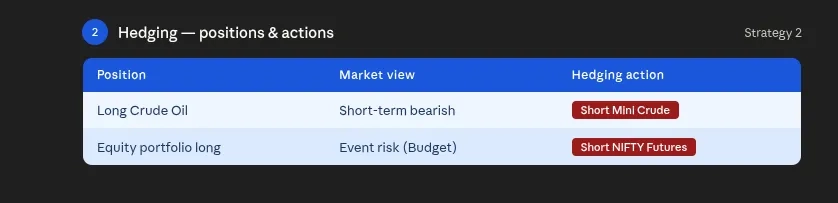
Real Example – Crude Oil:
Suppose you have 1 lot of long Crude Oil futures and fear short-term volatility:
- Hedge: Short Mini Crude futures
Pro Tip: Use SEBI-compliant research notes for pre-event hedging strategies—this prevents
panic-driven losses.
3. Calendar Spread Strategy – Profit from Time and Price Differences
What is This Strategy?
In a Calendar Spread, you simultaneously buy and sell the same commodity or index futures with different expiries. The goal is to profit from the spread movement between the two series.
When to Use:
- When market direction is unclear but you expect volatility shifts
- During rollover weeks to capture time-value differences
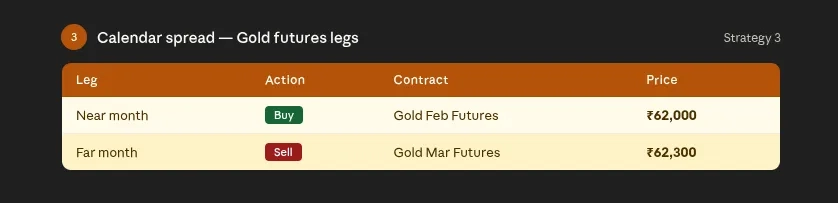
Real Example – Gold Futures:
- Buy Gold February Futures @ ₹62,000
- Sell Gold March Futures @ ₹62,300
If the spread (₹300) widens to ₹500, you profit ₹200 per lot.
Pro Tip: Use a Spread Analyzer Tool—it tracks contract-wise spreads and basis points in real-time.
4. Breakout Strategy – Trade the Momentum Explosion
What is This Strategy?
Markets often move sideways before big breakouts. This strategy identifies these accumulation zones and trades with momentum confirmation.
Indicators to Use:
- Bollinger Bands
- VWAP and Volume Surge
- Open Interest Jump
When to Use:
- Before high-impact news
- During post-consolidation phases
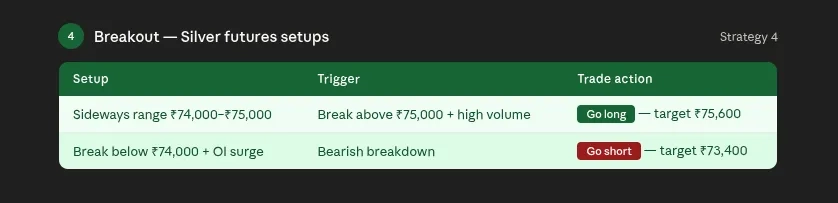
Real Example – Silver Futures:
Silver futures consolidate between ₹74,000–₹75,000 for 3 days.
- Price breaks ₹75,000 + volume and OI surge → Buy
- Stop Loss: ₹74,800
- Target: ₹75,600
Pro Tip: Use AI-based volume breakout scanners—they catch early moves without manually scanning hundreds of charts.
5. Mean Reversion Strategy – Systematically Buy Low, Sell High
What is This Strategy?
Prices oscillate around their mean (average). When a commodity or index moves too far from its average, it tends to revert. This strategy identifies overbought/oversold situations.
Indicators to Use:
- RSI (Relative Strength Index)
- Bollinger Bands
- 20 or 50-period Moving Average
When to Use:
- In range-bound or low-volatility markets
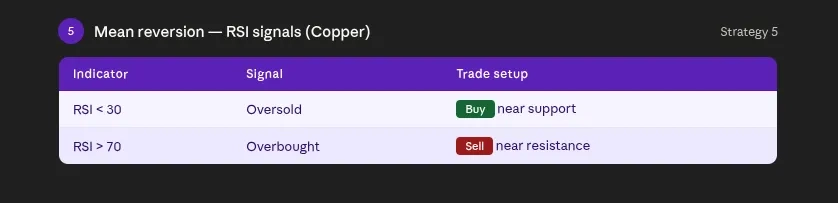
Real Example – Copper Futures:
- Copper Futures RSI drops below 30 → Oversold zone
- Price is near the lower Bollinger Band at ₹720 → Buy
- Target: Middle Band ₹730
- Stop Loss: ₹716
Pro Tip: Strict stop losses are essential in mean reversion. AI risk managers automatically calculate dynamic stop levels using ATR and volatility signals.
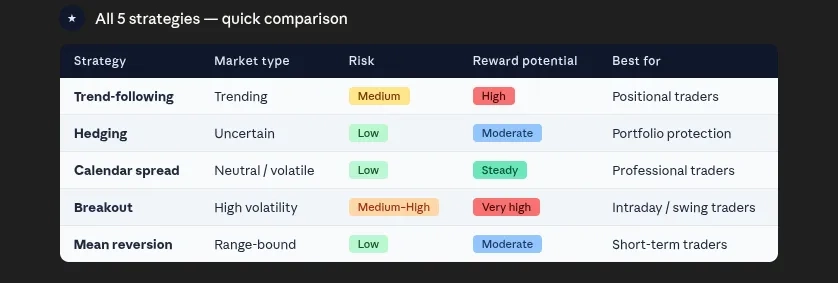
Quick Comparison Table
Conclusion
Futures trading is profitable only when combined with clear strategies, strong discipline, and reliable analytics. In 2026, combining Trend-Following, Hedging, Calendar Spreads, Breakout, and Mean-Reversion with AI-driven insights creates a powerful trading edge.